 Shaving peak demand and holding down costs with four decades of load management
by General Manager Steve Stroshane
and Member Services Manager Todd Schulte
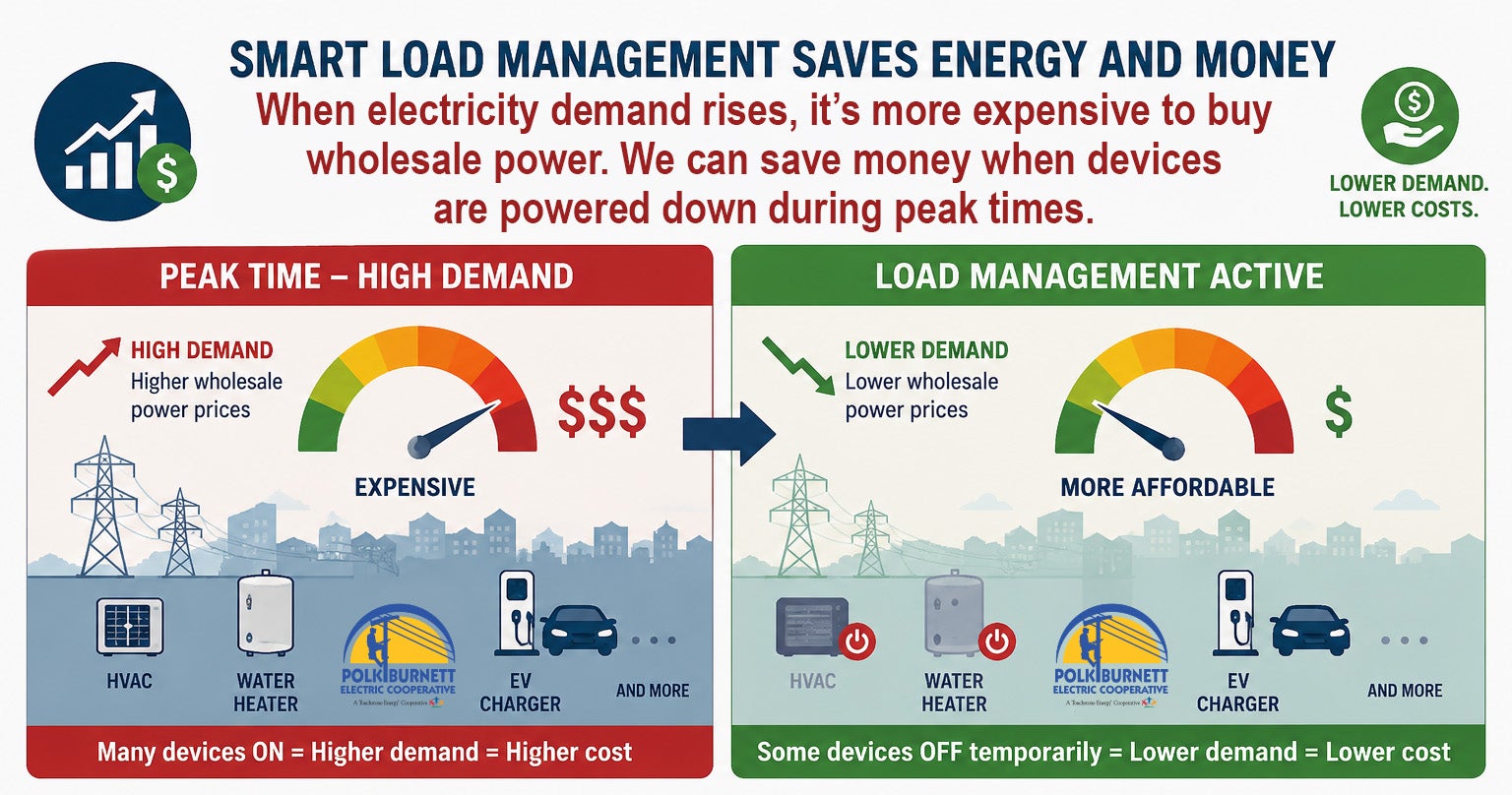
 As more load is added to the electric grid faster than new generation sources, the price of power at specific times of the year can spike. Polk-Burnett’s load management program is one of the ways that has successfully helped us hold down the cost of power since the 1980s. Today, load management is more important than ever as a strategy to control costs and balance supply and demand on the electric grid.
Our load management program temporarily controls power to participating devices in member homes; we do this to reduce energy demand during peak energy periods. If we can reduce the amount of electricity we buy during peak times, we can manage our wholesale power cost.
When members ask what the co-op is doing to hold down expenses, our load management program stands out as one of our most effective strategies, because it manages our cost for wholesale power.
We call this shaving the peak, and it’s a big deal, because the co-op’s cost to purchase wholesale power consumes 56% of our revenue, about $22 million annually. Our load management goal is to lower wholesale power costs and improve grid stability.
How does load management work?
Polk-Burnett’s load management program lowers energy demand by temporarily interrupting power to participating devices during periods of high electricity demand.
> Large water heaters are designed to store hot water for when it's needed. They are controlled every day, during daytime hours when prices are higher and recharge overnight when prices are lower.
> AC units are cycled off and on every 15 minutes during peak days in the summer.
> Electric heating systems, EV chargers, irrigation systems, grain drying and dairy water heaters are shut down during control periods, usually four to six hours.
Peak times are periods of the day when demand for energy is highest across the regional grid. In winter, it typically occurs in the morning, when people are getting ready for work and school, and businesses are ramping up. In summer, it’s in the afternoon and early evening, when people are coming home from work and school, turning on appliances and AC, cooking meals and doing laundry.
Control periods usually last about four to six hours. Even though they occur on the coldest and hottest days of the year when demand for energy peaks, our load management program is designed so most members notice little to no impact on comfort while helping to reduce system demand.
Why do members want to participate?
Participating members agree to let us control devices throughout the year, some in exchange for a reduced rate, some receive rebates on EV chargers, and some receive discounts on water heaters and electric thermal storage (ETS) units.
We’d like to thank our members who participate in load management. You help shave the peak, which benefits all of us with lower wholesale power costs and improved grid stability.
Sign up to receive load control notifications
Updating load management receivers
Currently, we have more than 7,000 devices across our system that can be used to shave peak load. In 2025, we began a modernization program to install new receivers for all load management devices.
This is a multi-year upgrade that will improve control strategies, communication and transparency for enrolled devices when energy demand and prices are high.
To date, co-op technicians have installed about 1,000 new receivers and we are on target to complete about 100 every month. We are making good progress and anticipate a 2030 completion date, about five to six years systemwide.
The new receivers use cell phone technology to communicate, not a radio signal. Connecting via cell service has pros and cons. In some areas with poor cell service, the new receivers may not get a strong control signal. Our modernization program uses three different cell carriers, T-Mobile/US Cellular, AT&T/FirstNet and Verizon, and we are working to improve the connectivity.
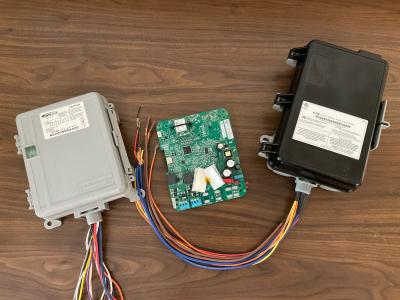 Before installing a new receiver, our technicians always test cell signal strength. With this information, they can determine the best way to upgrade the receiver and whether to install it inside near the electrical panel or outside near the meter.
Some members will receive a new receiver, black box shown at right. Some will receive a new board in their existing box, center and left.
The old receivers relied on radio towers operated by Dairyland Power Cooperative. Now, the control signal comes from cell phone towers.
How can you help?
If you participate in our load management program, we will send you an email asking you to contact us and schedule a convenient time for a co-op technician to perform the upgrade. There is no charge for this service. Watch for our email and reply when you receive it or give us a call to schedule at your convenience, 800-421-0283, ext. 318. Thank you!
Beat the Peak
Even if you do not have devices enrolled in load management, you can help beat the peak by turning off unnecessary lights and electronics, adjusting your heat or AC, and waiting for off-peak hours to charge EVs and run large appliances like your oven, dishwasher, clothes washer and dryer. When we all work together to reduce energy during peak times, we protect the power grid and help control costs.
Is your water heater due for replacement?
Consider an electric storage water heater
Special member price: just $1,050 on load control
A 100-gallon Marathon water heater is an investment that pays for itself in energy savings. When you install it on the off-peak rate, it's one of the most cost-effective ways to heat water for your home. It operates like a large battery by charging overnight when power prices are low and stores hot water for use throughout your day!
> Durable, built to last with corrosion-free tank.
> Backed by co-op service and Marathon warranty.
Contact us to order and start saving energy and money, 800-421-0283, x318.
Water heater webpage